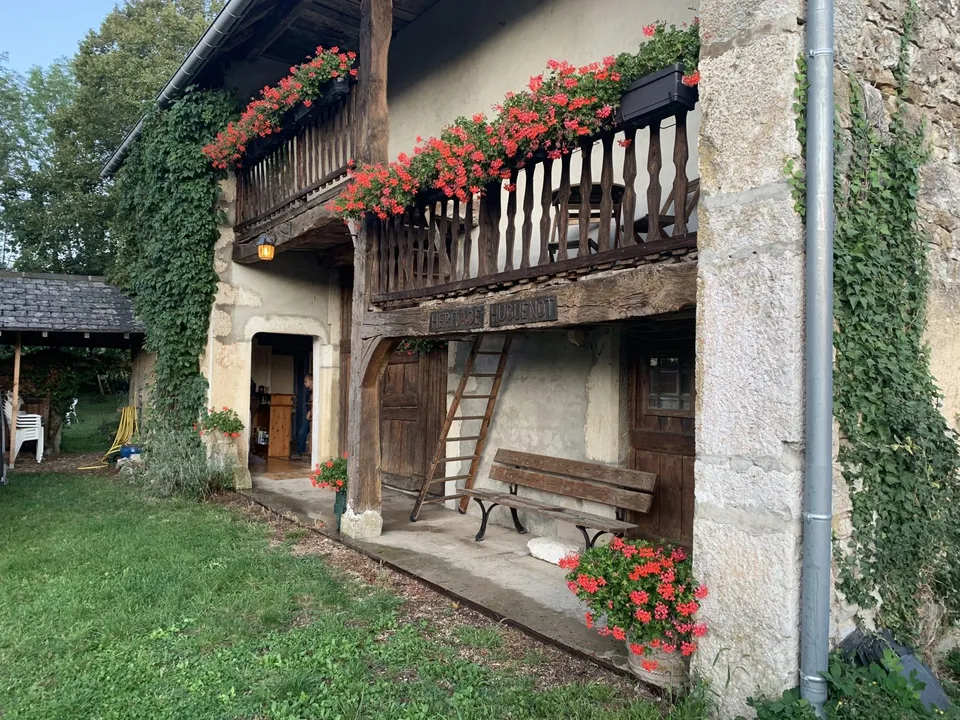
Our Huguenot heritage
American Christians have a long-standing connection to their French brethren of the past. The Huguenots were the Christians of the Reformation in sixteenth-century France — and their story is why this ministry exists.
What the Huguenots gave the church
Long before the name “Huguenot” was coined, Jacques Lefèvre d’Étaples was translating the Scriptures into French. John Calvin, a Frenchman, wrote his Institutes of the Christian Religion and led the Reformation in Geneva alongside his countrymen Guillaume Farel and Théodore de Bèze. The printer Robert Estienne gave the New Testament its verse numbers in 1551. Louis Bourgeois composed the melodies of the Genevan Psalter — including the tune English-speaking churches still sing as the Old Hundredth.
The Reformed churches of France confessed their faith together at La Rochelle in 1559, and by the middle of the century perhaps one in ten French people had joined them.
Persecution, and a faithful remnant
The cost was enormous. Thousands were killed in the Saint Bartholomew’s Day massacre of 1572, among them the Huguenot leader Admiral Gaspard de Coligny. The Edict of Nantes brought a fragile peace in 1598; its revocation by Louis XIV in 1685 outlawed Protestant worship altogether, and hundreds of thousands fled to Switzerland, Holland, Prussia, England, South Africa and the American colonies.
Those who stayed worshipped in secret in the “Church of the Desert.” Marie Durand was imprisoned for thirty-eight years in the Tower of Constance at Aigues-Mortes; all she had to do to walk free was say “I recant.” She never did. The word carved into the stone of her cell — register, “resist” — is still there.

The Huguenot cross
Shortly after the revocation of the Edict of Nantes, the Huguenot cross became the emblem of the Reformed faith in France. It is a Maltese cross of four arms; the eight points stand for the eight Beatitudes of Matthew 5. Between the arms are four fleurs-de-lis for the four Gospels, their twelve petals for the twelve apostles. The dove hanging beneath it is the Holy Spirit.
The Glorious Return
In the Alps, the Waldensians — the Vaudois, Protestants before the Reformation who joined it — suffered alongside the Huguenots. After the massacre of 1655 the survivors fled to Geneva. In 1689 the pastor Henri Arnaud led them back across the mountains to their valleys, singing Psalm 68: “Let God arise, let his enemies be scattered.” They called it la Glorieuse Rentrée, the Glorious Return.
That is the hope Huguenot Heritage carries: not nostalgia for a lost Protestant France, but a return — of the Gospel the Reformers preached, to the French-speaking world that once heard it.
Remember to lift up your eyes to that everlasting kingdom of Jesus Christ.
John Calvin, to the prisoners in Lyon, 1553
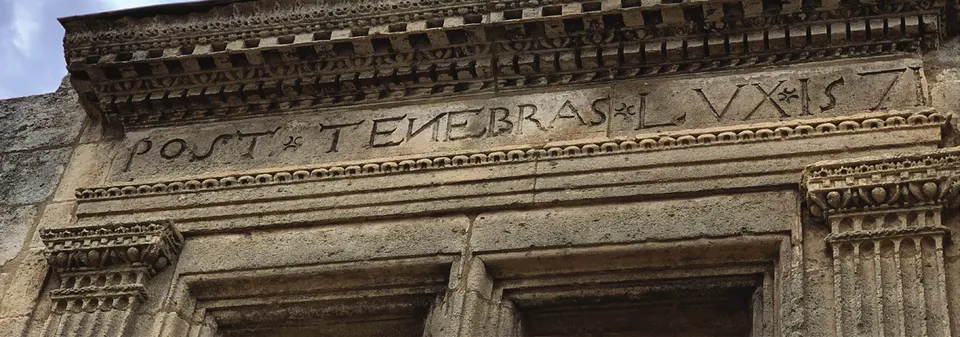
Post tenebras luxWhy "Huguenot Heritage"?
The Huguenots were the Christians of the Reformation in France. They gave the world Calvin’s Institutes, the Genevan Psalter, the verse numbers in your Bible — and, after 1685, a diaspora of refugees whose faith shaped Holland, Prussia, South Africa and America. Today fewer than one in a hundred French people is an evangelical believer.
Huguenot Heritage exists to carry that Gospel back — to France, and to the French-speaking world it once reached — using the Roman roads of our day: video, the internet, a flash drive in a pastor’s pocket.